

About our course
What
We teach Southern Quechua (spoken in Bolivia and in the south of Peru) we an important focus on speaking (oral comprehension and oral expression).
To learn more about our values and methodology click here 🔗
When
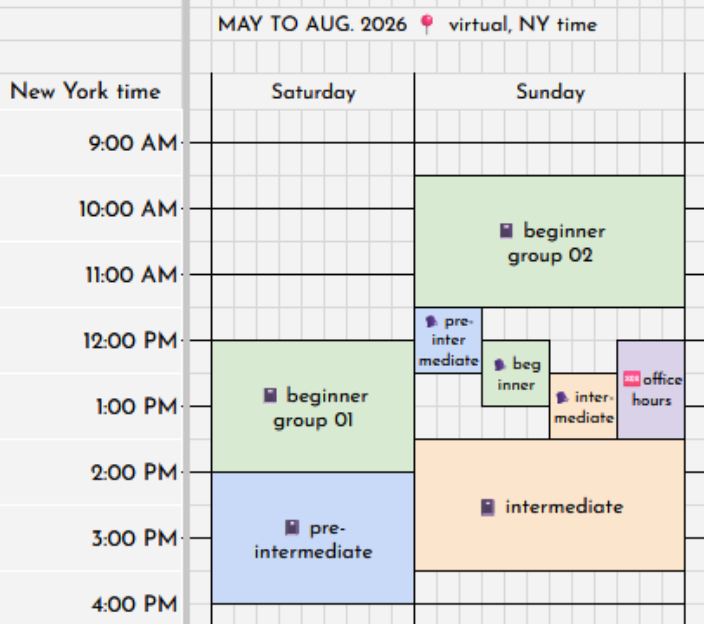
The course lasts 12 weeks from May 30th to Aug. 22nd 2026.
Class time depends on the level and the type of week:
Regular week:
Exam week:
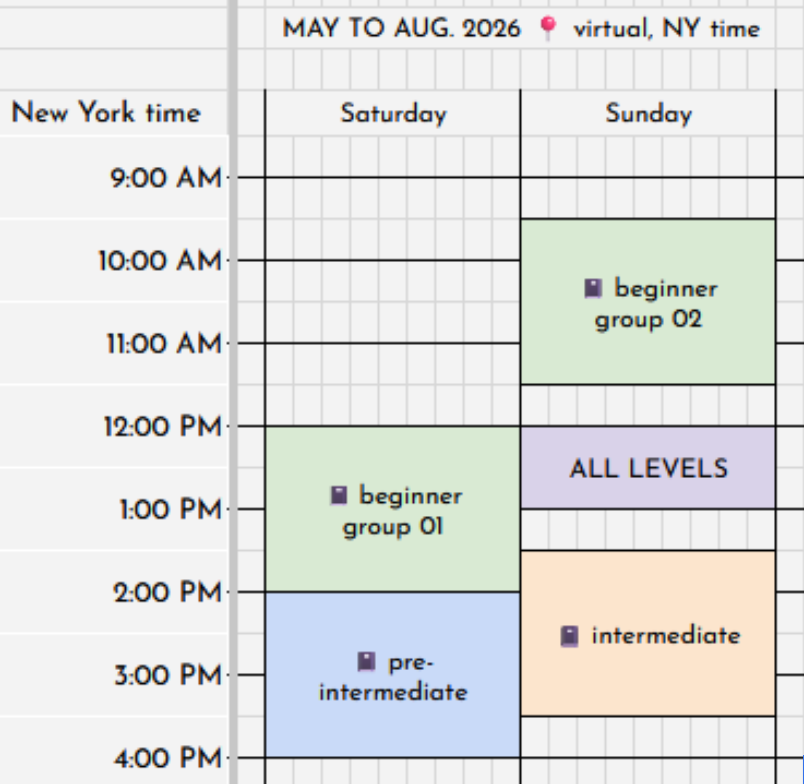
All weeks except weeks 1, 2, 6, 11 and 12 are regular weeks.
Cick on 🔗 to see a clear week-by-week calendar.
How
The 12-week course is made of up:
📖 grammar classes
🎧 listening classes
🗣️ speaking classes
📌 group projects
🆘 office hours (optional)
💯 midterm & final exams
🎓 a certificate of completion
Where
This course is fully online.
You can check other modalities here 🔗
How much
Our course costs 10 USD / class hour.
The course meets 3h / week for 12 weeks.
Installment payments are available upon request below 🙂
Request installment payment
Ready to register?
Yes!
I'm not sure what level to choose...
If you already have STRONG foundations in quechua, you can take a placement test. The placement test:
- takes place during week 01 or week 02 of class
- consists in an oral and a written exam for which you are strongly encouraged to prepare here 🔗
- is free but requires paying for the first 2 weeks of class beforehand (this amount will then be deducted from the cost of the course when signing up)
I have another question about the course...
Don’t hesitate to message us via email or whatsapp 🙂
For syllabus-related questions, see below:
More about our syllabi
How long is your entire Quechua course?
Our entire Quechua course takes about 4 years to complete.
You can see the detailed learning path in our Qhapaq ñan:
What will we learn in 📗?
Pragmatic objectives
The Beginner Quechua course is designed for you to be capable of meeting someone and getting to know them in quechua. Some of the (many) questions you should be able to ask and respond by the end of the course are:
- what’s your name?
- how are you doing?
- where are you from?
- how old are you?
- do you have kids?
- do you have siblings?
- do you have pets?
- how many?
- do you work or do you study?
- where do you work?
- where do you study?
- do you play an instrument?
- what instrument do you play
- do you speak aymara?
- etc.
Grammar objectives
The specific grammar objectives to master are:
- present tense conjugation
- possessive markers
- to have with kan
- to have with -yuq
- expressing “I don’t know” with -chá
- information structure with -qa/-taq/-pas and -m/-mi
- various other suffixes such as: -pi, -manta, -wan, -lla, -sqa, -chka-, -kuna, -ta, etc.
Exams
The oral exam will be done with a native speaker of Southern Quechua and consists in simulating an encounter with them and asking each other questions to get to know each other.
The written exam consists in checking students’ mastery of the paradigms above as well as their listening comprehension skills. They are expected to understand fully the 6 dialogues here 🔗 and similar interactions.
What will we learn in 📘?
Grammar objectives
The pre-intermediate course aims at equipping students with a set of 5 key conjugation paradigms:
- past tense with -r(q)a-
- future tense
- imperative mood
- conditional with -…man
- should and must with -na (+ kan)
… as well as other notions:
- difference between inclusive ñuqanchik vs exclusive ñuqayku
- expressing various degrees of knowledge with -m/-mi, -chá, -chushina, etc.
- various notions: time & manner adverbs, modal verbs (want, know) etc.
- various other suffixes such as: -q/-pa, -paq, -man, -hina, -spa, -cha, etc.
Pragmatic objectives
This course is delivered with two possible pragmatic focuses:
- Session A: getting to know a person better (childhood, habits & opinions)
- Session B: checking in with friends and family and making plans together
The types of questions you should be able to ask and answer by the end of the course are:
Session A
Questions:
- how did you learn to speak quechua?
- how did you learn to play the charango?
- what language do you speak with your parents?
- what language do you speak with your partner?
- when you were a kid, did you have pets?
- do you want to have kids?
- where would you want to live?
- what do you think we should we do to preserve quechua?
- what do you think politicians should do to preserve quechua?
- what would you do if you won the lottery?
- what do you do when you visit Bolivia?
Session B
Questions:
- what did you yesterday?
- what are you doing tomorrow?
- do you want to meet up?
- what could we do?
- what time should we meet up?
- etc.
Answers:
- yesterday I…
- tomorrow I’ll…
- yes let’s meet up!
- I can’t meet up, I have to work…
- we could go to the market
- let’s meet at 3pm
- etc.
Session A or B?
Once finishing the beginner course, you are ready to join any pre-intermediate course, whether A or B.
Given the high density of conjugation paradigms and the fact that the course is delivered with two different pragmatic focuses, we highly encourage students to take the pre-intermediate course twice in a row. However, it is always possible to move to intermediate and then return to take your missing pre-intermediate session.
In May 2026, we are offering session A.
What will we learn in 📙?
About the intermediate course
Once students join the intermediate course, they already master a very rich set of suffixes and paradigms allowing them to lead a basic conversation with a native speaker and to understand similar conversations between native speakers.
The goal of the intermediate course is to allow them to
- express themselves on a wider range of topics more authentically and with more depth and precision in Quechua, and
- improve significantly their listening comprehension skills moving away from didactic listening material towards more real-life authentic listening material.
To do so, in each intermediate course, they learn key suffixes or constructions to learn to manage key notions (aspect, embedded clauses, quoting speech, etc.) and they dedicate significantly more time to authentic listening comprehension.
Each intermediate session starts with the intermediate welcome package before moving on to the session-specific material:
Intermediate welcome package
- various suffixes: -q, -wa-, -naku, etc.
- various adverbs: with -ta, -lla, -man, -manta, etc.
- locative suffixes: -pata, -hawa, -ukhu, etc.
- past tense conjugations: past habitual and -sqa
- indefinite quantitative pronouns:
- existential (someone, no one, something, nothing, etc.)
- identity (anyone, anywhere, anything, etc.)
- quantitative (lots, few, etc.)
Session-specific material
- session A: evidential & verb-modifying suffixes
- session B: bipersonal suffixes
- session C: -ña, -raq, manaña, manaraq
- session D: -spa and -pti conjunctions
- session E: -sqa(ta) and -na(ta) clauses
- session F: quoting speech with nispa
In May 2026, we are offering intermediate session B.
Session A, B, C, D, E or F?
Once finishing the pre-intermediate course (whether session A or B), you are ready to join any session of the intermediate course – whether A, B, C, D, E or F.